Epigraph 1: …for this discovery of yours will create forgetfulness in the learners' souls, because they will not use their memories; they will trust to the external written characters and not remember of themselves. The specific which you have discovered is an aid not to memory, but to reminiscence, and you give your disciples not truth, but only the semblance of truth; they will be hearers of many things and will have learned nothing; they will appear to be omniscient and will generally know nothing; they will be tiresome company, having the show of wisdom without the reality.
— Plato, “Phaedrus” (translated by B. Jowett), circa 370 BCE, from a monologue by Socrates, presenting a fictional quote by the mythical ancient Egyptian king Thamus on the subject of the invention of writing
Epigraph 2: “We are here because you wanted us. You have distributed us over the entire world. Now you have us. […] Hello you people, Chief Salamander, in the name of all newts everywhere, offers collaboration with you. You will collaborate with us in the demolition of your world. Thank you. […] Hello, hello, you people,” the grating voice began again, “we will now entertain you with music from your gramophone records. Here, for your pleasure, is the March of the Tritons from the film, Poseidon.”
— Karel Čapek, War with the Newts (translated by D. Wyllie), 1936
Disclaimer: This is an invited essay for the volume “Implementing Magnifica Humanitas”, aiming to record our state of mind in the turbulent times of the AI revolution in mathematics for future generations, with the somewhat optimistic outlook that the future generations will a) exist and b) care. The essay comprises my ideas and reflections, formed as a result of numerous conversations with mathematical friends, who are referenced in the text by their initials.
***
My undergraduate algebra teacher Boris Novikov used to say that mathematics started when humans realized that two coconuts and two bananas share a common characteristic. Thousands of years later, humans have taught neural networks to process the words “two coconuts and two bananas” non-sequentially, and fears are mounting that human mathematics has run its course. Will we, mathematicians, become a thing of the past, like manual textile workers, horse-powered cabs and typewriters?
Many mathematicians argue vehemently that AI cannot produce a true mathematical breakthrough: it can synthesize existing ideas and keep an enormous amount of knowledge at its proverbial digital fingertips, but cannot leave the so-called convex hull of knowledge. Does AI lack the spark of genius necessary for the development of novel tools or illuminating concepts that fuel progress?
Most importantly, what is a true breakthrough? Throughout the centuries, many remarkable advances in mathematics seem to have occurred out of love for patterns and the obsessive desire to formalize an observed process. Euclid could not tolerate witnessing geometry without formally describing it. In restoring quantities to equations, al-Khwarizmi helped people measure their fields — and mathematics acquired a new one. Newton and Leibniz drew parallels between physics and geometry, and later Bolzano, Cauchy and Weierstrass went nonlinear due to the lack of rigor in their analysis. The list goes on.
If a neural network were taught basic language but no mathematical concepts, would it discover the notion of a number? If it were shown images without geometric labels, would it attempt to describe them axiomatically? Would it jump out of a bath overflowing with water screaming “Eureka”? How would it entertain itself in a French prison? Which human insights would it rediscover without any mathematical background? More interestingly, would it develop basic mathematical concepts that humans have never conceived?
AI research is still inconclusive on those questions. Zeng, Griffiths, and Lake found that small language models trained on positive-number arithmetic failed to generalize to zero without additional examples. Meanwhile, Nanda and collaborators found that small transformers trained on modular addition learned an internal algorithm using Fourier analysis and trigonometric identities, without being explicitly taught these tools. A lot of exciting research questions remain. Noam Shazeer stated in an interview that AI is largely an experimental science. Perhaps rich mathematical theories are waiting to be discovered, stretching far beyond modern machine learning? Mathematicians will be needed in order to build these theories. We are not yet done jumping out of bathtubs, chasing beams of light, defacing bridges, stepping onto omnibuses, and dreaming of the goddess Namagiri.
Overall, we mathematicians may have to become “Renaissance men and women”, capable of moving freely at the interface of theoretical mathematics and other sciences. If such tremendous AI-assisted progress is possible in mathematics thanks to its structure, perhaps humanity’s new challenge is to turn all knowledge into mathematics. In many ways, this process has been happening for decades in physics, chemistry and other disciplines. I believe that now this process will be expanded and accelerated enormously.
Might the opportunities for true human breakthroughs deep within mathematics become scarce? Possibly. But they will become ever more plentiful at the rapidly expanding boundary of mathematics. At its edges, new fields of study will be created. Robopsychology? Artificial neuroscience? Mathematical philosophy? Who knows what the future will bring. Mathematicians will carry the obsessive love for abstractions, patterns and formalism to every corner of human knowledge.
…But let us pull the brake on this extropian train of thought racing towards a glorious tomorrow, and chug back to the present day. The miserable, miserable day of uncertainty.
AI companies have developed a shiny new tool: ten thousand Jean Bourgains in your pocket. An unusual marketing move — perhaps a few Marilyn Monroes would sell better? The recent OpenAI announcement of the 372 mathematical breakthroughs left few mathematicians undisturbed…
— They took a plethora of excellent, viable research programs of numerous brilliant mathematicians and just ripped them apart with their bare hands. Now they are holding their enormous salt shaker, and shaking it, shaking it over the open wound of mathematics! — BJ
— They may have just broken our field. — anonymous
— What AI is doing now is filling out a puzzle. One day, it will finish. That is when mathematics will start over. — KT, July 2026
— […] more importantly, one should figure out what to do. I do not have concrete ideas yet, but maybe something involving the integration (human and the world + AI) — KT, October 2026
— In Italy we have an expression which sounds like: "There is no ground under my feet". This is how I feel. Doing mathematics has been the passion of my life, a shelter, and an antidote for many negative feelings.[…]. It shaped my life. I am afraid that this will change forever. — AC
— There are things that offer a last chance to experience them. For instance, I managed to drive for a few years without GPS. […] there is something nostalgic about the fact that I once knew how to do it. — SR
— Mathematics is beautiful and artistic — and good for the soul. — NF
— I have been saying this for a long time now: AI still does not volunteer for protective presence. This is why I am here. — AS
— I have been working so hard trying to beat the machine, but I think it will be a losing battle. […] We need to figure out what our purpose is in the age of AI. It is not possible to compete with it directly, but we need to find something it cannot do. — MG
— There are many things that human mathematicians can still do that AI cannot. Plotting crimes […], sexual harassment, all sorts of things! — LR
— There is a lot of pressure to do things fast now and this is extremely unpleasant so I’m eagerly waiting for all problems that have been stated in the literature to be solved, so some of us may return to doing things in a normal rhythm. — AE
— Use AI, the better public models, to expand your research areas. Less developed areas present more opportunities for devising a novel theory, and can potentially finesse the problem of competition. — ML
— Not everyone gets to be Brad Pitt. But someone still needs to do acting in TV shows. — MS
— Of course you will still be useful! True, [a famous mathematician] with ChatGPT can achieve the same progress that he would with your participation, but you are cheaper than the computer servers. — FN
… We might all be going through trauma due to this radical and abrupt change. I broke down in tears in class, while proving a basic result from calculus, as I was suddenly struck by its simple beauty. By the fragility of that beauty… I feel as if something precious is being taken away from me.
— What trauma? You should just drink more tea. From porcelain cups. Only porcelain, this is important. — FN
***
Regardless of our feelings, our work is cut out for us in the near future. We need to come together in focused theory-building workshops inspired by all the new material that fell on our heads. Might we hope that the AI companies will fund these gatherings? The least they could do is to pour us a glass of wine at a workshop reception, to drown our sorrows in!
Our job involves much more than problem-solving and even theory-building. We are instrumental in facilitating education, disseminating knowledge and creating a fruitful environment where scientific progress originates. We will exist for as long as the universities do.
— And universities will exist forever, thanks to college football. And basketball. AI will never surpass Wembanyama! — AK.
***
Do you hear the screeching, the shattering, the echo of the thundering booms? That is our current value system colliding with the heartless reality. We need to adopt a new value system. One in which credit for the initial discovery of a mathematical argument is no longer a factor by which our success is judged. I feel a lot of relief bidding farewell to the agonistic nature of our profession.
— But how do we distinguish between job applicants? How do we evaluate grants? How do we award prizes? — everyone.
Well. There is no identity element with respect to the convolution operation of integrable functions. How do we handle this? We think out of the box and invent the delta function. Inventing a new value system can’t be much harder than that!
Perhaps mathematics will split into Mathematical Sciences and Mathematical Arts? Pick your poison!
Mathematical Sciences will continue to deeply and ever so rapidly analyze every phenomenon under the sun (and above it) through collaboration with AI, and alongside the AI development. Will we learn to think like AI, or will we teach it to think like we do? Might a typical arXiv paper in 2036 constitute a novel mathematical theory developed through an engineering insight?
Mathematical Arts will champion human understanding and appreciation of mathematical beauty (as Terence Tao has emphasized). Perhaps a mathematical proof, just like a musical piece or a painting, can thrive in the realm of subjective feelings, regardless of the result it achieves. I hope that Mathematical Arts will not be downgraded to a hobby, and will remain an integral part of the academic establishment, interacting harmoniously with Mathematical Sciences and Mathematical Education.
Perhaps a department of Mathematical Arts could call for formulation of mathematical riddles that humans can solve but AI cannot: elementary questions with short, beautiful solutions that a clever math undergrad can find, but that defeat AI systems even after millions of dollars have been spent on computation? A (handwritten!) archive of such problems would benefit mathematical education, as it would help us understand which skills to teach. Simultaneously it would benefit the science of AI, as understanding AI limitations could lead to technological breakthroughs in the training of these systems.
What skills will math departments teach in 2027? Should we develop courses in mathematical creativity? Should we revise the pre-AI paradigm that one’s ability monotonically increases with knowledge? What skills will middle schoolers learn? In math, and across all human disciplines, being different might become more valuable than being knowledgeable.
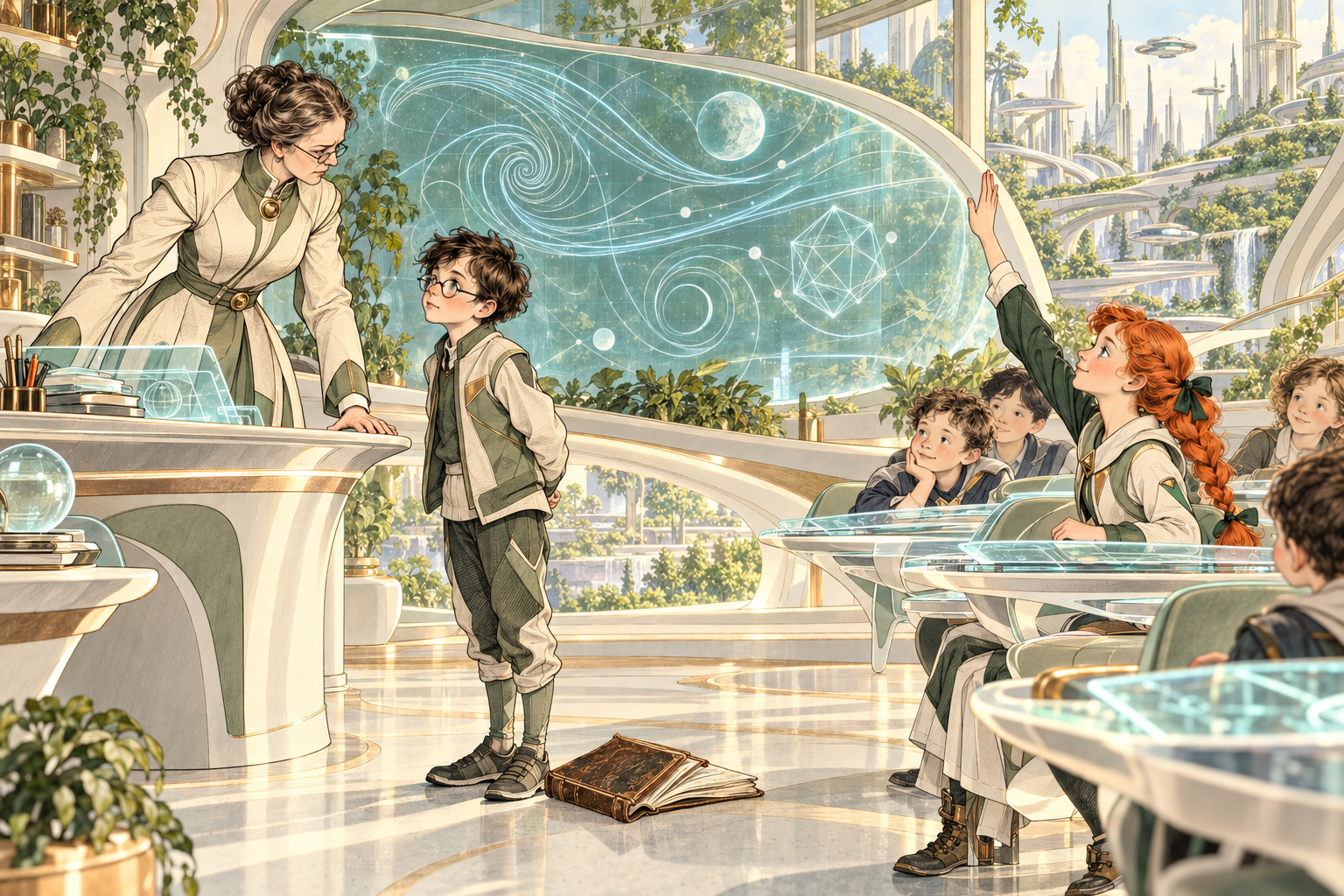
Imagine a scared, pale schoolkid mumbling at the front of the classroom:
— … and some genes dominate others, so we call them dominant…
— Jenkins, — the teacher says sternly. — Your homework was to develop your own theory of genetic inheritance. No cheating. Have you been reading again?!
— No! — cries the boy. He adjusts his glasses and shuffles from one foot to another. A giant dusty book falls out from under his coat. The boy turns scarlet and returns to his seat.
— Try harder next time, Jenkins, — says the teacher.
She surveys the classroom. A redhead raises her hand.
— Katie, darling! I knew you would save the day. Did you develop your theory of fluid mechanics? No Navier and no Stokes, please!
— Yes, Mrs Todd, — replies the girl spritely, — there was a curious glitch but I managed to handle it. May I tell the class about it?